(pib.gov.in)
Cervical cancer remains one of the biggest health threats to women in India.
Cervical cancer remains one of the biggest health threats to women in India. It is the second most common cancer among Indian women and one of the leading causes of cancer-related deaths. According to the WHO’s GLOBOCAN 2022 data, India reports over 1.2 lakh new cases and nearly 80,000 deaths each year. Most cases are caused by persistent infection with high-risk types of the Human Papillomavirus (HPV), especially types 16 and 18.
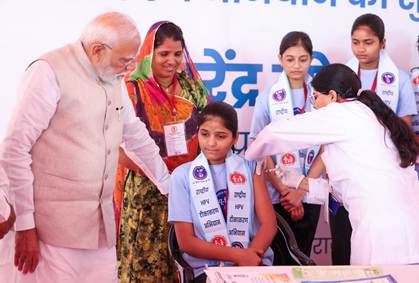
In a major step to tackle this burden, the government has launched a nationwide HPV vaccination campaign for 14-year-old girls. Recently, Prime Minister Narendra Modi rolled out the drive from Ajmer, Rajasthan, describing it as a historic milestone in the fight against cervical cancer. The campaign will provide a free, voluntary, single-dose HPV vaccine to eligible girls at government health facilities across the country.
Under the programme, around 1.2 crore girls aged 14 years are expected to be covered every year. Vaccination will be carried out for 90 days in campaign mode and later integrated into routine immunisation services. The vaccine will be administered at government facilities such as Primary Health Centres, Community Health Centres and district hospitals. Consent from parents or a guardian is mandatory, and beneficiaries can pre-register on the U-WIN digital platform or opt for walk-in vaccination.
India’s programme uses the quadrivalent Gardasil-4 vaccine in a single-dose schedule, in line with global scientific evidence and World Health Organisation recommendations. Health officials say HPV vaccines are highly effective in preventing cervical cancer caused by the targeted virus types and also provide broader community protection when coverage is high.
However, experts caution that introducing the vaccine is only part of the solution. A recent review article published in the Indian Journal of Medical Research has highlighted significant challenges in improving vaccine uptake. The study notes that to increase coverage, “multi-level barriers” must be addressed through “integrated public health initiatives and policy interventions.” The review article was authored by Kripa Josten, Redolen Rose Dhar, Bhageerathy Reshmi, Veena Natti Krishna, and J. Vennila from Manipal College of Health Professions, Manipal Academy of Higher Education, Manipal, Karnataka.
The findings show that awareness remains extremely low. According to NFHS-5 data cited in the review, less than 1% of girls in India are vaccinated against HPV, and only around 2% of women have ever undergone cervical cancer screening. This gap is far from the global goal of 90% coverage needed to eliminate cervical cancer as a public health problem by 2030.
One of the key findings across 37 studies reviewed between 2009 and 2025 was the “extremely low baseline awareness of HPV and its vaccine” among adolescents and their parents. In many conservative and rural settings, cultural barriers persist. Some communities associate HPV only with sexual transmission, which creates hesitation and stigma around vaccinating young girls.
The review stresses the need for “multifaceted strategies,” including education campaigns, community engagement and “culturally tailored interventions.” Financial support and clear communication from trusted health workers are also essential to build confidence.
Public health experts say school-based awareness drives, involvement of local leaders and better communication about the vaccine’s safety record could help address fears and misinformation. They also point out that vaccination should go hand in hand with improved screening services for adult women.
The government says it has undertaken extensive preparations, including training healthcare workers and strengthening cold chain systems to ensure safe delivery. Vaccination sessions will be supervised by trained medical officers, and systems are in place to monitor and manage any rare adverse events.
The nationwide rollout marks a significant step in preventive healthcare. If implemented effectively and supported by strong awareness campaigns, the HPV vaccination drive can drastically reduce cervical cancer cases in the coming decades. However, as the recent research makes clear, success will depend not just on supply of vaccines, but on overcoming social, cultural and informational barriers that have long limited access to this life-saving protection.